
The apartment search can often feel like you’re just waiting for someone else to make a decision about your future. You submit your personal information into a void and hope for the best, paying a new fee with every application. Renter-paid screening changes that dynamic by putting you firmly in the driver's seat. It’s built on the idea that you should have ownership over your own data. You pay for one report, you see exactly what’s on it, and you decide which landlords get access. This approach gives you control, protects your privacy, and saves you money. Let's explore how does renter paid tenant screening work to give you a competitive edge and more command over your housing search.
If you’ve ever been on the apartment hunt, you know the drill. You find a few places you love, and you apply to all of them, hoping one works out. The catch? Each application comes with a non-refundable fee, and before you know it, you’ve spent a few hundred dollars just for the chance to be considered. Renter-paid tenant screening is changing that experience.
Think of it as your personal rental passport. Instead of paying a separate fee to every landlord for a new background check, you pay for one comprehensive screening report that you own and control. This portable tenant screening report includes all the essential details a landlord needs, like your credit history, a nationwide criminal background check, and any past evictions. You can then share this single, secure report with multiple landlords, saving you time and money. It puts you in the driver's seat of your rental journey, giving you full transparency and control over your personal information.
In the traditional rental process, landlords are the ones who run the background check. They typically pass the cost of this screening on to you through an application fee. While this is standard practice, it means you’re paying for a new report every single time you apply for a property. If you’re applying to three, four, or even five places in a competitive market, those fees add up fast.
With a renter-paid model, the process is flipped. You proactively get your own screening report from a trusted service. The key difference is ownership. Instead of paying a landlord for a report you never see, you pay for a report that belongs to you. You decide who to share it with and when, making the entire process more efficient and cost-effective.
This shift toward renter-paid screening is all about empowerment. Creating and using a portable report simplifies the entire application process. With your screening information ready to go, you can apply for new listings the moment they hit the market, giving you a competitive edge. It’s not just about speed and savings; it’s also about privacy. You get to see exactly what’s on your report and control who has access to your sensitive data.
A quality tenant screening service gathers all the critical information a landlord needs in one place, making you a more organized and prepared applicant. By taking control of your screening, you’re not just saving money on fees, you’re making your rental search smoother and more secure.
Switching to a renter-paid screening model might sound like a big change, but the process is actually quite simple and designed to be intuitive for both renters and landlords. Instead of the old way, where landlords collect application fees and run background checks themselves, this approach puts the renter in control. The renter pays for a single, comprehensive screening report and can then share it with multiple landlords. This saves everyone time, reduces costs, and adds a layer of transparency to the rental process.
The entire system is built on the idea of a secure, reusable report. Think of it as a passport for your rental history. You get it once and can show it wherever you go, without having to start from scratch every time. This renter-driven approach streamlines everything from the initial application to the final review. Let’s walk through the four main steps to see exactly how it works in practice.
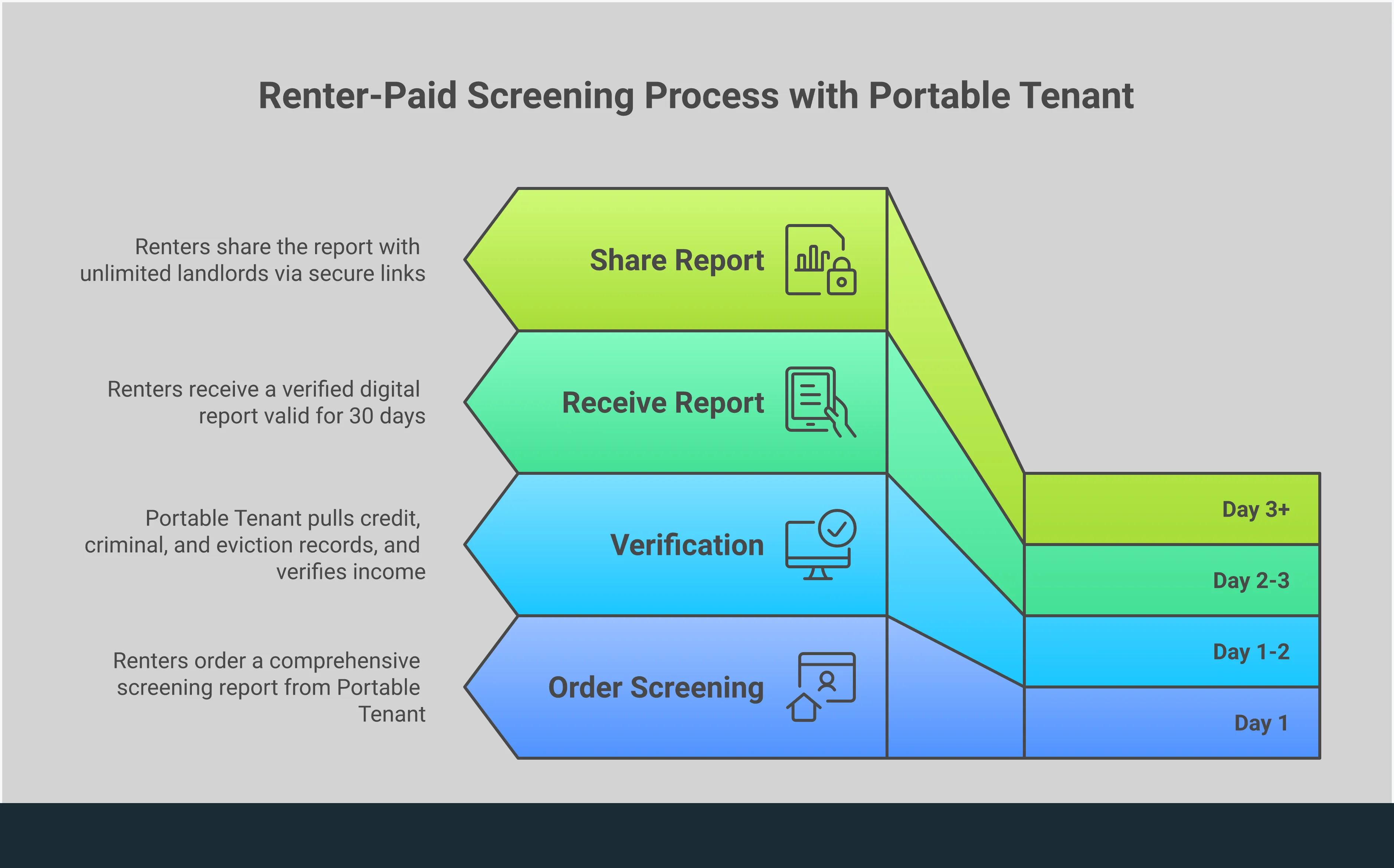
The process begins with you, the renter. Instead of paying a separate application fee for every apartment you're interested in, you order one report. Portable tenant screening reports are essentially background checks that you can use across multiple rental applications. You pay a one-time fee for a report that’s valid for 30 days, allowing you to apply to as many places as you like within that window. This simple first step is a game-changer, saving you from the frustration and expense of repeated fees while you search for your next home.
Once you request your report, the screening service gets to work. A tenant screening report is a landlord's window into an applicant's background, giving them the information needed to choose a reliable renter. To create this comprehensive picture, the service securely pulls your information from trusted sources. This includes your credit history from a major bureau like Experian, a nationwide criminal background check, and a search of eviction records. The goal is to gather and verify all the essential data in one place, creating an accurate and reliable snapshot for potential landlords.
After your information is compiled and verified, it’s packaged into a secure, easy-to-read digital report. This report belongs to you. When you're ready to apply for a rental, you simply share your portable tenant screening report with potential landlords. Most services, including Portable Tenant, provide a secure link that you can send via email or include in your rental application. You have complete control over who sees your information and for how long, which protects your privacy throughout your housing search.
Once you share your report, the landlord can access it instantly. For landlords, validating portable tenant screening reports is a crucial step to ensure the information is accurate and trustworthy. Because they receive the report through a secure, third-party platform, they can be confident that the data is authentic, up-to-date, and hasn't been tampered with. The landlord reviews your credit, criminal, and eviction history alongside your application, allowing them to make a quick and informed decision. This final step closes the loop, making the screening process faster and more secure for everyone involved.
When you create a renter-paid screening report, you’re essentially building a comprehensive rental resume. This report gathers all the key information a landlord needs to see that you’re a responsible and reliable applicant. Think of it as your chance to put your best foot forward, all in one neat, secure package. Instead of filling out a new application and paying a fee for every apartment, you get one detailed report that you can share with multiple landlords.
A thorough report gives a landlord a complete picture, covering everything from your financial habits to your rental history. For landlords, this information helps them make informed decisions and choose tenants who are a good fit for their property. For you, the renter, it means transparency and control. You know exactly what information is being shared because you’re the one sharing it. Let’s break down the four main components you’ll find inside a typical portable screening report.
Your credit report tells a story about your financial responsibility. It gives landlords a look at how you manage your money, including whether you pay your bills on time and how much debt you carry. Landlords use this information to gauge how likely you are to pay your rent consistently. A strong credit history can make your application stand out.
A comprehensive screening service pulls your full credit report and score from a major credit bureau like Experian. This isn't just a summary; it’s the real deal. It shows active credit accounts, payment history, and any collections or public records. This gives a potential landlord a clear and fair view of your financial background, helping them feel confident in their decision.
A criminal background check is a standard part of the screening process. This search scans national, state, and local databases for any relevant criminal records. It’s important to know that landlords can’t just use this information however they want. Fair housing laws provide guidelines on how a criminal history can be considered, focusing on whether past offenses are recent or relevant to being a tenant.
For example, landlords are often advised to consider the nature of an offense, how long ago it occurred, and what you’ve done since. The goal is to assess potential risk, not to unfairly disqualify applicants. A good screening report provides accurate, compliant information, giving the landlord the necessary details while protecting your rights as a renter.
An eviction history shows a landlord if you’ve ever been formally removed from a rental property by a court order. This is a major red flag for property managers, so it’s a critical piece of your rental history. The report will show any eviction filings or judgments against you.
However, context matters. Landlords often want to understand the circumstances behind an eviction. Was it for non-payment of rent, or was it related to other lease violations? While any eviction can make your search tougher, having a single, isolated incident from years ago is very different from a recent pattern of issues. A detailed report provides this history, giving you a chance to explain the situation if needed.
Landlords need to know you can comfortably afford the rent, and that’s where income verification comes in. This part of the report confirms your employment and how much you earn. Typically, you’ll provide documents like recent pay stubs or bank statements to prove your income. Many landlords use the "3x rule," meaning they like to see that your monthly income is at least three times the monthly rent.
Modern screening services make this process simple and secure. Instead of emailing sensitive documents back and forth, you can use a platform to safely upload your information. The service then verifies the details, providing the landlord with a confirmation of your income without exposing all your personal financial data.
Tenant screening isn't a free-for-all; there are important rules in place to protect both renters and landlords. While renter-paid screening puts more power in the applicant's hands, landlords still have a responsibility to follow the law. Think of it as a framework that ensures the process is fair, transparent, and consistent for everyone involved. Getting this right isn't just about avoiding legal trouble; it's about building trust and starting a landlord-tenant relationship on the right foot.
Navigating these rules can feel a bit overwhelming, but it boils down to a few key principles. Landlords must handle sensitive information responsibly, get clear permission before digging into someone's background, and apply their screening criteria equally to all applicants. These rules come from federal, state, and sometimes even city-level regulations. Understanding them is non-negotiable for any landlord who wants to run a smooth and ethical rental business. For renters, knowing your rights helps you spot red flags and ensures you're being treated fairly throughout your housing search.
At the heart of tenant screening regulations is a major federal law: the Fair Credit Reporting Act (FCRA). This law governs how consumer information, including the details in a tenant screening report, is collected and used. For landlords, this means you need a legitimate reason, or "permissible purpose," to review an applicant's report, which in this case is their application to rent your property. The FCRA is designed to promote accuracy, fairness, and privacy of personal information assembled by credit reporting agencies. It ensures that the data used to make big decisions, like approving a rental application, is handled with care and transparency.
You can't review a potential tenant's personal information without their go-ahead. Before you even look at a screening report, you must get clear, written permission from the applicant. This is a non-negotiable step that protects everyone. Furthermore, if you decide to deny an application based on something you find in their report, you have to let them know. This is called an "adverse action notice." You'll need to tell them why they were denied, which screening company provided the report, and that they have the right to see the report and dispute any inaccurate information. This transparency is a key part of a fair screening process.
While the FCRA sets the national standard, your compliance journey doesn't end there. Many state and local laws add another layer of rules you need to follow. For example, some cities and states put a cap on how much you can charge for an application or screening fee. In New York, it’s limited to $20. Other laws address portable screening reports directly, outlining how they must be accepted. It's also important to know that in many places, you cannot reject an applicant based on their source of income, meaning you must consider applicants who use housing vouchers or other forms of rental assistance. Always check your local regulations to stay current.
Renter-paid screening isn't just a new trend; it's a smarter way to handle the rental process for everyone involved. It creates a more balanced, efficient system where both renters and landlords come out ahead. By shifting the process, it addresses key pain points for both sides of the rental equation, making the experience smoother and more secure.
If you've ever felt like the rental application process was a black box, you're not alone. Renter-paid screening puts you back in the driver's seat. You get one comprehensive report and decide which landlords see it, saving you from paying separate application fees for every apartment you like. This approach not only saves you money but also gives you full transparency. You can review your own report before you even start applying, so you know exactly what information landlords are seeing. It’s about giving you control over your personal data and making your apartment search less stressful and more straightforward.
For landlords, the benefits are just as significant. By having applicants provide their own screening reports, you can reduce your administrative workload and costs. The process becomes much more efficient, helping you fill vacancies faster with qualified tenants. Since renters come to you with a complete, verified report in hand, you get consistent and reliable information every time. This streamlines your decision-making and ensures you’re meeting all compliance standards without the usual back-and-forth. It’s a simple way to improve your property management workflow and focus on finding the best fit for your property.
Let’s clear up a common worry: will applying for multiple apartments tank your credit score? The short answer is no. It’s a myth that tenant screening automatically damages your credit. When you initiate your own screening report, it’s considered a soft inquiry. Unlike hard inquiries, which happen when you apply for a loan or credit card, soft inquiries don't impact your credit score at all. This means you can share your report with as many landlords as you need to without any negative consequences. It’s one less thing to stress about while you’re searching for your next home.
When you're deep in the apartment hunt, application fees can feel like a constant drain on your wallet. The good news is that the renter-paid screening model is becoming more transparent and, in many places, more regulated. Let's break down what you can expect to pay and the rules that protect you from excessive fees.
In most rental situations, the applicant is the one who pays the screening fees. Traditionally, this means paying a separate fee, often between $25 and $75, to every single landlord you apply with. If you're applying for multiple apartments in a competitive market, those costs can add up fast. This is where the model is changing for the better. With a portable screening report, you pay a single, transparent fee to generate a comprehensive report that you can share with as many landlords as you like. This approach not only saves you money but also puts you in control of your personal information. You can see exactly what our one-time pricing covers and how it simplifies your search.
To protect renters from sky-high application costs, many states and cities are putting caps on what landlords can charge. For example, in New York, landlords can’t charge more than $20 or the actual cost of the background check, whichever is less. This prevents them from profiting off application fees. These laws also reinforce that landlords must get your written permission before running any checks. Using a service that understands these nuances is key for landlords who want to stay compliant and for renters who want a fair process. A compliant screening process ensures everyone is following the rules and builds trust from the start.
Renter-paid screening is a fantastic step forward, but like any process, it has a few potential bumps in the road for both renters and landlords. Being aware of these challenges ahead of time can help you have a much smoother experience. The main things to watch for are the financial impact on tenants applying to multiple places, the need for landlords to verify that reports are legitimate, and the ever-important task of staying on the right side of the law.
The traditional model often forces renters to pay separate application fees for every single apartment they're interested in, which can get expensive fast. For landlords, the big question is trust. How can you be sure the report a renter provides is accurate, complete, and hasn't been altered? And for everyone involved, navigating the web of local and federal regulations can feel like a full-time job. Understanding these hurdles is the first step to overcoming them, and thankfully, the right screening service can solve most of these issues before they even start. By choosing a secure and compliant platform, both parties can move forward with confidence.
If you've ever been on the apartment hunt, you know how quickly application fees can add up. In the traditional setup, landlords often pass the cost of tenant screening directly to the applicant. While a single fee might seem manageable, paying it three, four, or even five times can put a real strain on your budget. This is especially true in competitive rental markets where you need to apply for several places just to secure one.
This is where a portable screening report completely changes the game. Instead of paying a new fee to every landlord, you pay once for a comprehensive report that you can share with multiple properties. This approach not only saves you money but also streamlines your application process, letting you act fast when you find the perfect place. You can learn more about how a single, reusable report is priced to see how much you could save.
For landlords, the biggest concern with renter-provided documents is authenticity. It’s essential that you can trust the information you receive to make a fair and informed decision. As one industry expert notes, "validating portable tenant screening reports is a crucial step to ensure the information is accurate and trustworthy." A simple PDF sent over email can be easily altered, leaving you vulnerable to fraudulent information.
A professional screening service eliminates this risk entirely. Instead of the renter downloading and sending the report themselves, the service provides a secure way to share it directly with you. This is usually done through a secure, time-sensitive link that gives you access to the original, verified report. This secure process ensures the data is coming straight from the source (like Experian) and hasn't been tampered with, giving you complete peace of mind.
Navigating the legal side of tenant screening can be tricky for landlords. Laws regarding application fees, credit checks, and the acceptance of portable reports can vary significantly from one state to another. While landlords in most states have the right to charge an applicant for a credit check, new legislation is changing the rules, especially in places that now mandate the acceptance of portable reports.
Staying current with these regulations is non-negotiable. Using a dedicated screening service helps you stay compliant without having to become a legal expert yourself. These platforms are built to adhere to Fair Credit Reporting Act (FCRA) guidelines and are updated to reflect state-specific laws. By relying on a compliant screening partner, you can be confident that your process is fair, legal, and protects both you and your potential tenants.
Picking a tenant screening service can feel like a big decision, and it is. The right service streamlines the application process for everyone, while the wrong one can cause delays and security risks. Whether you're a renter trying to land your next home or a landlord looking for a reliable tenant, you need a service that is secure, thorough, and easy to use. Here’s what to focus on to make sure you choose a great one.
First things first: your personal information has to be protected. As a renter, you’re sharing sensitive data, and you need to trust that it’s in safe hands. Look for a service that uses bank-level security and gives you control over who sees your report and for how long. For landlords, this is just as critical. You have a legal responsibility to keep applicant information secure, so choosing a compliant and secure platform is essential. A trustworthy service will be transparent about its security measures and how it protects everyone involved.
A screening report should give a complete picture. This means it needs to include all the key details landlords look for: credit history, a nationwide criminal background check, and any past eviction records. But a great report is also reusable. A portable tenant screening report allows renters to pay one fee for a comprehensive check and then use that same report for multiple applications. This saves you from paying application fees over and over again. For landlords, it means you get a consistent, detailed report without managing the payment process yourself.
An unverified report isn’t worth much. The best screening services use reliable sources and robust methods to confirm the information they provide. This includes pulling data directly from major credit bureaus like Experian and offering tools for income verification. As a landlord, you need to be confident that the report you’re reviewing is accurate and trustworthy. For renters, a verified report strengthens your application and shows you’re a serious candidate. Before committing to a service, find out how it validates its information to ensure you’re getting a report you can count on.
Renter-paid screening reports can simplify your application process, but your responsibilities as a landlord don’t end there. Following a few key best practices will help you stay compliant, treat every applicant fairly, and build a reputation that attracts high-quality tenants. Think of these steps as your playbook for a smooth and professional screening process that protects both you and your potential renters.
Before you even list your property, decide on your tenant selection criteria and write them down. This includes things like minimum credit score, income-to-rent ratio, and any rules about rental or criminal history. By providing these written guidelines to every single applicant, you create a transparent process and ensure you’re applying the same standards to everyone. This consistency is your best defense against accusations of discrimination and is a core principle of the Fair Housing Act. It makes your decisions easier to justify and shows applicants you’re operating a fair and professional business.
Documentation is your friend. For every applicant, you should keep a file with their application, the screening report you received, and any important communications like emails or texts. Most importantly, jot down your reasons for approving or denying their application, referencing your pre-set criteria. This habit might seem tedious, but it creates a clear record of your decision-making process. If a dispute ever arises, you’ll have organized documentation to show that you followed a consistent and fair procedure. It’s a simple step that offers significant peace of mind.
Operating fairly is not just good practice; it’s the law. You must follow federal regulations like the Fair Credit Reporting Act (FCRA) when using screening reports to make rental decisions. A critical part of this is providing an adverse action notice if you deny an applicant based on information in their report. This notice must state the reason for the denial and identify the screening company that provided the report. Using a compliant service like Portable Tenant for landlords helps streamline this, but the responsibility for transparency ultimately rests with you. It builds trust and shows respect for every person who applies.
Renter-paid tenant screening is a modern approach that puts tenants in the driver's seat while making the application process much smoother for landlords. Instead of landlords collecting application fees to cover screening costs, this model lets prospective renters pay for their own background check directly. This simple shift creates a more transparent and efficient system for everyone involved.
For renters, this is a huge step forward. You get to take charge of your rental application by ordering your own comprehensive report. The best part? You can reuse that same report for multiple applications, which is a lifesaver in competitive markets. No more shelling out separate application fees for every apartment you like. This not only saves you money but also gives you full control over your personal information, letting you share it securely and confidently.
Landlords see major benefits, too. Passing the cost of screening to the applicant reduces your out-of-pocket expenses and administrative workload. But it’s not just about saving money. A quality tenant screening service gives you a complete picture of an applicant’s financial and rental history, all verified and ready to review. This helps you assess candidates quickly and fill vacancies with qualified tenants, creating a more streamlined and effective process from the start.
Ultimately, renter-paid screening builds a more balanced and trusting rental ecosystem. It empowers tenants with ownership over their data and saves them from redundant fees. At the same time, it provides landlords with the detailed, reliable information they need to make great decisions without the financial burden. It’s a smarter, fairer way to handle one of life’s biggest moves, ensuring both parties can move forward with confidence.
How is a renter-paid report different from a regular application fee? Think of it this way: a traditional application fee pays for a single background check that a landlord runs and you never get to see. A renter-paid screening report is a product you buy for yourself. You pay once for a comprehensive report that you own and control, allowing you to share it with as many landlords as you need within a set time frame. It’s an asset for your apartment search, not just a one-time cost.
Will ordering my own screening report hurt my credit score? Not at all. When you request your own screening report, the credit check is considered a "soft inquiry." Unlike the "hard inquiries" that happen when you apply for a new credit card or loan, soft inquiries are only visible to you and have no impact on your credit score. This means you can share your report confidently without worrying about it affecting your credit.
How do landlords know the report I share is real and not fake? This is a great question and a key feature of a secure screening service. You don't just download a PDF and email it. Instead, the service provides a secure, unique link for you to share with landlords. This link takes them directly to the verified report on the platform, ensuring the information is authentic, up-to-date, and hasn't been altered in any way.
How long can I use my report, and what if a landlord wants a more recent one? Your portable screening report is typically valid for 30 days, which gives you a solid window to apply to multiple properties during an active housing search. Most landlords accept reports within this timeframe. If your search takes longer or a specific landlord has a stricter policy, you may need to generate a new report, but the goal is to cover your entire search with one payment.
Are landlords required to accept my portable screening report? This depends entirely on state and local laws. In a growing number of places, like Colorado and Washington, landlords are legally required to accept a portable report from a qualified source. In other areas, it may be up to the landlord's discretion. It's always a good idea to ask a potential landlord upfront if they accept reusable reports before you apply.