
The number of people working for themselves is growing every year, which is great news for landlords. These driven, independent professionals can make for fantastic, long-term tenants. The only challenge is that their proof of income looks different from the standard W-2 employee. A single bank statement might not tell the whole story, and a tax return from last year might not reflect their current success. Learning how to verify income for a self-employed tenant is no longer an edge case; it’s a core skill for any modern landlord. This article provides a straightforward framework for confidently assessing their financial health, ensuring you can welcome great tenants without the guesswork.
When a self-employed applicant wants to rent your property, their proof of income won't look like a typical pay stub. Instead of a single, straightforward document, you'll need to piece together their financial story from several sources. Your goal is to get a clear and accurate picture of their income to make sure they can comfortably afford the rent. The good news is that with the right combination of documents, you can verify their earnings with confidence. It’s all about knowing what to ask for and how to read the story those documents tell.
This process is less about a simple yes or no and more about understanding the stability and consistency of their business. A single month's bank statement might look great, but what about the rest of the year? A 1099 form shows significant revenue, but how much of that was eaten up by business expenses? By looking at a few key financial documents together, you can build a reliable snapshot of their financial health. This approach protects your investment and helps you find great, responsible tenants who happen to work for themselves. Let's walk through the most common and effective documents you should request to get a complete view of a self-employed applicant's income.
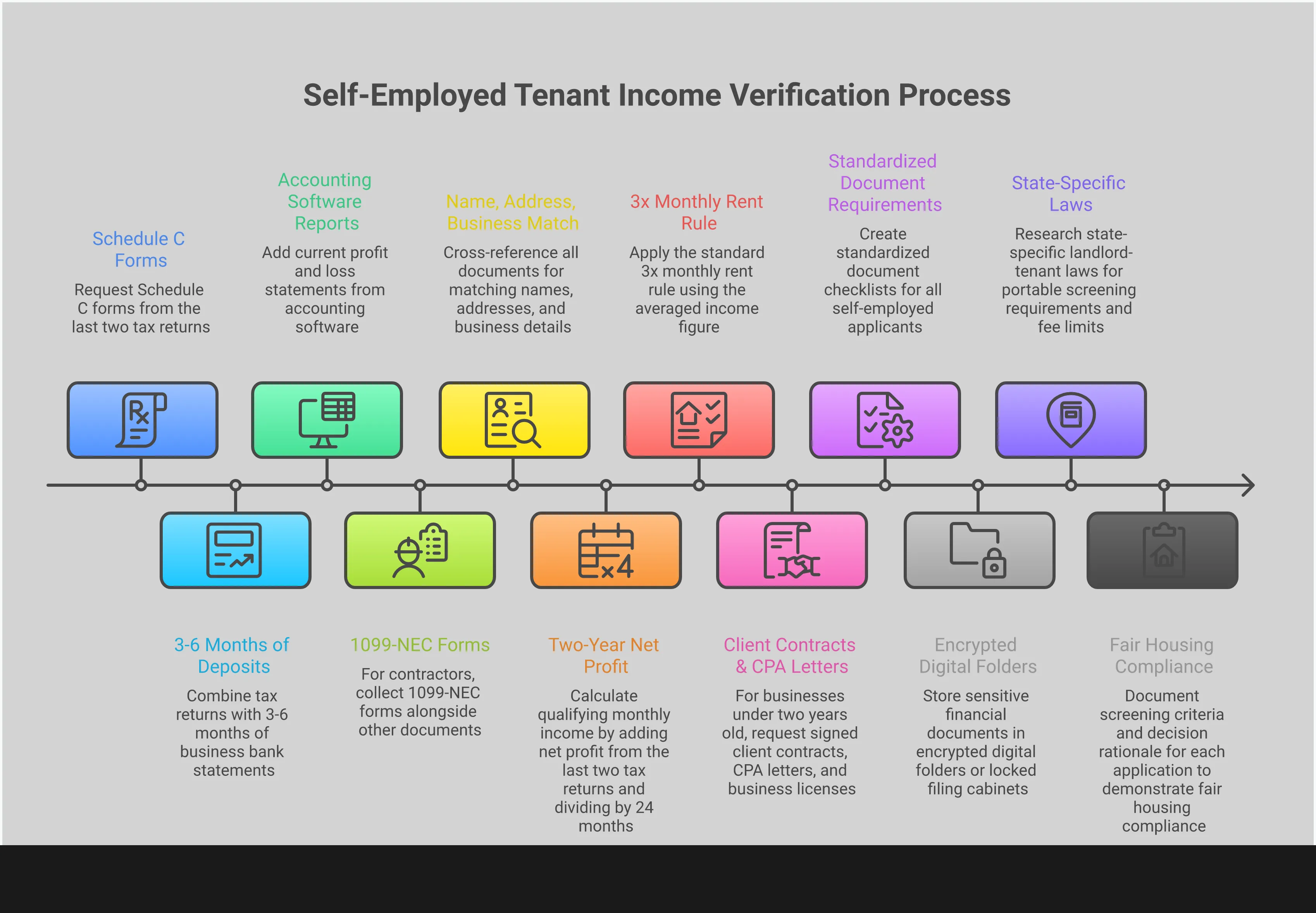
This is the most reliable document you can get. A personal tax return, specifically the Schedule C (Form 1040), is designed to report profit or loss from a business. It gives you a clear, government-verified look at their finances. When you review it, pay close attention to the net profit line, not the gross income. The gross income shows all the money their business brought in, but the net profit shows what’s left after they’ve paid for all their business expenses. That final number is what they actually have available to pay for things like rent. Asking for the last two years of tax returns will give you an even better sense of their income stability.
If your applicant works as an independent contractor, they’ll likely receive 1099 forms from their clients. These forms, like the 1099-NEC, report the total amount of money a client paid them during the year. While helpful, 1099s only show gross earnings and don't account for business expenses. A freelancer might have $80,000 in 1099s but only $50,000 in actual take-home pay after costs. For this reason, you should always ask for 1099s alongside other documents, like their tax return or bank statements. This combination helps you connect the dots between the money they received and what they actually earned.
Bank statements are your window into an applicant's real-time cash flow. Ask for the last three to six months of their business bank statements to see how consistently money is coming in. You’re looking for regular deposits that support the income they’ve claimed on their application or profit and loss statement. This helps you confirm that their business is currently active and generating revenue, not just relying on past success. While bank statements don’t show the full picture of profitability on their own, they are an excellent tool for verifying the numbers presented in other documents and spotting any inconsistencies. They show that the business has a healthy, ongoing financial pulse.
A profit and loss (P&L) statement, also known as an income statement, is a financial report that summarizes a business's revenues, costs, and expenses over a specific period. It’s a straightforward way to see if the business is making money. The applicant can usually generate this report from their accounting software or have their accountant prepare it. The most important line for you is the net income at the bottom, which shows their profit after all expenses are paid. While a P&L is a great summary, it’s best to verify the information by cross-referencing it with bank statements or a tax return to ensure everything lines up accurately.
Once you have the documents from a self-employed applicant, your real work begins. Unlike a traditional employee with a straightforward W-2 and predictable pay stubs, a freelancer or business owner’s income can be variable and more complex to assess. That’s why vetting their papers is so crucial for verifying their income and ensuring they can reliably pay rent. Think of it less like being an auditor and more like piecing together a puzzle. Your goal is to build a clear and accurate financial story from the documents they provide. This process is one of the most important things you can do to protect your investment and find a great, responsible tenant for your property.
Taking these extra steps builds confidence in your decision and prevents potential issues down the road. While it might seem like more effort upfront, a careful review is the best way to confirm that an applicant's entrepreneurial spirit is matched by their financial stability. It shows you’re a diligent landlord and sets a professional tone for the tenancy. Ultimately, understanding how to properly vet these documents is a key skill for any landlord who wants to open their doors to the growing number of self-employed professionals. It helps you make an informed choice based on solid evidence, which is the foundation of a successful rental business.
This is the most straightforward check. Start by laying out all the documents and looking for consistency in the basic details. Compare information like names, addresses, and business names across their application, tax returns, and bank statements. Do they all match up? A simple typo might not be a dealbreaker, but significant discrepancies could be a red flag. This initial step helps confirm you’re looking at a cohesive set of documents from the same person and business, setting a solid foundation for the rest of your review.
Next, move from personal details to the numbers. The income reported on their tax returns should align with the deposits shown in their bank statements. For example, if an applicant claims $80,000 in annual income, you should see an average of around $6,600 in monthly deposits. Look at their profit and loss statement and see if the revenue figures match what’s going into their bank account. Small variations are normal, but large, unexplained gaps between what they claim to earn and what their bank records show are worth a follow-up conversation.
Trust your gut. If something feels off, it’s worth a closer look. Be on the lookout for signs of fraudulent documents, such as blurry logos, inconsistent fonts, or numbers that look too perfect. A quick online search can also be revealing. Does their business have a website or a social media presence? Can you find their business registration online? If an applicant claims to be a successful freelance graphic designer but has no online portfolio or professional footprint, it’s fair to ask for more information to verify their business is legitimate.
For self-employed individuals, gross income doesn't tell the whole story. You need to understand their net income, which is the profit left after business expenses. A freelancer might gross $100,000, but if they have $40,000 in expenses, their qualifying income is closer to $60,000. When reviewing their Schedule C or P&L statement, pay attention to the types of expenses. Some write-offs, like a home office or mileage, are "paper expenses" that don't reduce their actual cash on hand. Other costs, like inventory or contractor payments, directly impact the money available for rent.
While tax returns and bank statements are the cornerstones of income verification, they don't always tell the whole story. For self-employed applicants, a few extra documents can provide a much clearer picture of their financial health and the legitimacy of their business. Think of these as supporting evidence that builds a stronger, more complete application. Requesting these documents helps you assess an applicant's stability beyond a simple income number, giving you the confidence to make a well-informed decision. It shows you’re doing your due diligence while giving the applicant more ways to prove they’re a great choice for your property. By looking at a wider range of financial proof, you can better understand their business's consistency and long-term viability, which is crucial when their income isn't from a traditional W-2 job. This approach not only protects your investment but also creates a fairer process for entrepreneurs who have a solid financial footing but lack conventional paperwork. It’s about piecing together a complete financial puzzle, not just looking at one or two pieces.
A single year of high earnings can be an outlier, but a consistent income over two or three years demonstrates true stability. Asking for multiple years of tax returns is one of the most reliable ways to see an applicant's financial track record. This long-term view helps smooth out the natural ups and downs of self-employment and shows that their business isn't just a recent, temporary success. It proves they can sustain their income over time, which is exactly what you want in a tenant. This historical perspective is invaluable for understanding their true earning potential and their ability to consistently cover rent.
Does the applicant run a formal, legitimate business? Asking for copies of business licenses or registration documents can answer that question. Documents like an LLC formation certificate, a professional license, or a "Doing Business As" (DBA) registration show that the applicant is serious about their work. It signals a level of professionalism and long-term commitment that a casual side hustle might lack. These official documents confirm that the business is recognized by the state or local government, adding a significant layer of credibility to their application. It’s a simple way to verify that their income source is a well-established and properly structured enterprise.
Bank statements show money that has already been earned, but what about future income? Copies of current client contracts and recent invoices can provide a fantastic preview of an applicant's upcoming earnings. Signed contracts demonstrate committed work for the months ahead, while a steady stream of recent invoices shows they have an active and paying client base. For freelancers and project-based entrepreneurs, these documents are key to proving ongoing work and a reliable cash flow. Reviewing them helps you confirm that their business is currently active and generating the income they claim, ensuring they can comfortably afford the rent.
Sometimes, the best verification comes from a third party. A letter from a Certified Public Accountant (CPA) can confirm an applicant's income and the financial health of their business. This is a powerful endorsement from a qualified professional. Similarly, a reference letter from a long-term client can speak to the applicant's reliability and the consistency of their work. When requesting these, ask that they be on official letterhead and include contact information for follow-up. These references add a personal, yet professional, layer of validation that financial documents alone can't provide, giving you a more holistic view of the applicant.
Once you have all the documents, it’s time to make sense of the numbers. Calculating a self-employed applicant’s income isn’t as simple as looking at a pay stub, but it’s completely doable with the right approach. The key is to look at their financial history holistically to get an accurate and fair picture of what they can comfortably afford. Unlike a salaried employee with a predictable bi-weekly check, a freelancer or business owner's income can ebb and flow. A single great month doesn't guarantee stability, just as a slow month doesn't signal financial trouble.
To get a true sense of their earning power, you’ll need to assess their income over a longer period, account for natural business cycles, and apply standard rental industry metrics. This method helps you make an informed decision that protects your investment while giving a deserving applicant a fair shot. It’s about looking beyond a single data point and seeing the bigger financial picture. By following a few straightforward steps, you can confidently determine if a self-employed applicant has the consistent income needed to be a great, reliable tenant for your property. This process builds trust and sets the stage for a positive landlord-tenant relationship from day one.
A single bank statement showing a large deposit doesn't tell the whole story. For a reliable picture of an applicant's financial health, you need to look at their income over a longer period. The best way to do this is by reviewing their tax returns from the last two or three years. Tax documents provide a verified, long-term view of their earnings history, which helps smooth out any unusually high or low months. To get a qualifying monthly figure, simply add up the net income from the past two years and divide by 24. This average gives you a much more stable and realistic baseline for what they earn each month.
Many self-employed professionals, like photographers or landscapers, have income that varies with the seasons. A slow winter doesn't necessarily mean they're struggling financially; it might just be the nature of their business. That’s why looking at a full year’s worth of income is so important. When you review their bank statements or profit and loss statements, look for patterns and consider the annual total rather than a single month’s deposit. An applicant’s proof of income should reflect these cycles, and averaging their annual income will give you the most accurate monthly figure. This shows you understand the realities of self-employment and are evaluating them fairly.
A common standard in property management is the income-to-rent ratio, which helps ensure a tenant can afford the rent without financial stress. Typically, landlords look for an applicant to have a monthly income that is two to three times the monthly rent. You can apply this same standard to self-employed applicants using the averaged monthly income you just calculated. For example, if the rent is $2,000 per month, you’d want to see a consistent, averaged monthly income of at least $6,000. This simple rule of thumb is a reliable way to gauge affordability and minimize your risk, no matter how the applicant earns their living.
It’s important to know the difference between gross and net income. Gross income is the total amount of money the business brings in, while net income is what’s left after all business expenses are paid. When evaluating an applicant, you should focus on their net income, as this is the money they actually have available for personal expenses like rent. Tax returns are perfect for this, as they clearly show the adjusted gross income. While some business expenses might be flexible, the net income figure provides the most conservative and accurate measure of their ability to pay.
Sometimes, a self-employed applicant won't have two years of tax returns, especially if their business is new. This doesn’t automatically make them a risky tenant; it just means you need to be flexible. If a tenant can't provide traditional proof of income, you have several other options to consider. Exploring these alternatives can help you confidently assess an applicant while still protecting your investment.
Instead of relying solely on tax documents, ask for a combination of other financial records. A series of recent bank statements can show consistent cash flow and a healthy account balance. You could also request copies of signed client contracts or major invoices to see their projected earnings for the next few months. A letter from a certified public accountant (CPA) summarizing their financial standing can also be a powerful substitute. The goal is to piece together a clear and current picture of their financial stability, even if the traditional paperwork isn't available.
If an applicant has a thin financial history, bringing on a co-signer or guarantor can be a great solution. This is common for recent graduates or people just starting their freelance careers. A co-signer is someone, often a parent or relative, who legally agrees to pay the rent if the tenant cannot. It’s essential that you screen the co-signer just as thoroughly as you would the primary applicant. This means running a full credit check and verifying their income to ensure they can comfortably cover the rent on top of their own expenses. This approach provides a strong safety net for you and gives a promising applicant a chance.
Another way to add a layer of security is by adjusting the initial payment terms. You might consider asking for a larger security deposit, which can give you more of a cushion. However, it's critical to check your local and state laws first, as many jurisdictions have strict security deposit limits. If your state allows it, you could also ask for the first and last month's rent upfront. This shows the applicant is financially prepared and reduces your risk in the early stages of the lease. Always make sure any adjusted terms are clearly outlined in the lease agreement and comply with all regulations.
Manually piecing together financial documents can be time-consuming and tricky. This is where professional screening services come in. Using a comprehensive screening report simplifies the entire process by verifying income through secure, tech-driven methods. These services can quickly confirm an applicant's financial data, often by connecting directly to their bank accounts with their permission. This not only saves you time but also significantly reduces the risk of fraudulent documents. It streamlines verification for everyone involved and helps you make a faster, more informed decision based on verified information rather than paperwork alone.
Verifying income for a self-employed applicant can feel like a puzzle, but it doesn’t have to be. The key is clear, respectful communication. Their financial story might not be told through traditional pay stubs, but with the right approach, you can get a complete picture of their stability and ability to pay rent. A positive conversation from the start sets a collaborative tone and helps you gather the information you need without making the applicant feel scrutinized. Remember, a thriving freelance business or a successful solo venture is a sign of discipline and drive, qualities that can make for a great tenant.
By being upfront about your requirements and flexible in your approach, you can make the process smoother for everyone. This isn't just about checking boxes; it's about understanding their unique financial situation. Using a comprehensive service can streamline this entire conversation, as a portable screening report often includes verified income data, making your job much easier. The goal is to build a relationship based on transparency, which starts with how you talk about their income.
The best way to avoid confusion is to be crystal clear from the very beginning. Before an applicant even starts gathering their documents, let them know exactly what your income requirements are, such as the common "3x the monthly rent" rule. Explain that while you understand they don't have W-2s, you still need to verify a consistent and reliable income stream. By setting these expectations early, you empower them to put together a strong application. This simple step shows you’re a professional and organized landlord, and it helps applicants determine if the property is a good financial fit for them before they invest time and money into the application process.
To make things even easier, give self-employed applicants a simple checklist of the documents you accept. This takes the guesswork out of the process and ensures you get what you need. Your list could include items like the last two years of tax returns (including Schedule C forms), the three most recent months of business bank statements, and a year-to-date profit and loss statement. You might also ask for copies of 1099 forms, client contracts, or invoices to show current and future work. Providing a clear list of proof of income options helps applicants feel prepared and respected, leading to a much more efficient screening process.
The life of a freelancer or business owner doesn't always run on a predictable schedule. They might be waiting for an accountant to finalize their quarterly reports or for a large client payment to clear. While you need to keep your process moving, showing a little flexibility can go a long way. If an applicant communicates that they need a few extra days to get a specific document, consider granting a reasonable extension. This doesn't mean putting your rental on hold indefinitely, but a bit of understanding can help you secure a responsible, long-term tenant who just happens to have a non-traditional income flow.
Create a space where applicants feel comfortable talking openly about their work and finances. A self-employed person's income might fluctuate seasonally, or they may have just landed a major contract that isn't reflected in last year's tax return. Encourage them to provide context. You could ask questions like, "Can you tell me a bit about your business and how your income typically flows throughout the year?" Listening to their story can provide valuable insight that documents alone can't offer. This dialogue helps you assess their overall financial health and builds a foundation of trust from day one.
Verifying a self-employed applicant's income is about more than just crunching numbers. It's also about navigating a web of rules and regulations designed to protect both you and the applicant. Staying compliant isn't just good practice; it’s the law. A fair and consistent process protects you from potential legal trouble and helps build a foundation of trust with your future tenant from day one.
Think of compliance as your roadmap for the screening process. It ensures you treat every applicant equally, handle their sensitive information with care, and follow the specific rules for your area. Getting this right from the start saves you headaches down the road and reinforces your reputation as a professional, trustworthy landlord.
The most important rule to follow is the Fair Housing Act, which prohibits discrimination based on race, color, religion, sex, disability, familial status, or national origin. When it comes to income verification, this means your process must be consistent for every single applicant. If you ask one self-employed person for two years of tax returns and a profit and loss statement, you should ask for the same documents from any other self-employed applicant.
Creating a standardized checklist for different employment types can help you stay on track. The key is to avoid making exceptions or asking for different types of proof from different people, as this could be seen as discriminatory. Your goal is to evaluate each applicant on the same financial criteria, ensuring your decision is based purely on their ability to pay rent.
When an applicant hands over their tax returns, bank statements, and other financial records, they are trusting you with incredibly sensitive information. It's your responsibility to protect it. Whether you store documents in a locked filing cabinet or in a secure, encrypted digital folder, you must take steps to prevent unauthorized access. Limit who can view these files to only those directly involved in the screening decision.
Handling data responsibly is a cornerstone of being a good landlord. Be mindful of data protection laws and have a policy for how long you keep application documents and how you dispose of them securely. Using a professional service for screening can simplify this, as they are built with bank-level security to handle and protect applicant data properly.
Landlord-tenant laws can vary significantly from one state to another, and even between cities. What’s standard practice in one location might be against the rules in another. For example, some states have specific laws about portable screening reports or may limit the application fees you can charge. It’s crucial to get familiar with the regulations in your specific area.
Take some time to research your state and local landlord-tenant laws, or consult with a legal professional. Understanding these rules helps you create a compliant screening process from the start. This is where a service designed for compliance, like Portable Tenant, becomes invaluable. It helps you meet legal requirements, especially in states with specific portable screening laws, ensuring your process is both effective and by the book.
Verifying income for a self-employed applicant can feel like putting together a complex puzzle. You have to gather various documents, cross-check figures, and make an educated guess about their financial stability. It’s a time-consuming process that leaves room for error and uncertainty. This is where professional screening services come in to make life easier for everyone.
Instead of manually vetting every document, you can use a comprehensive service that does the heavy lifting for you. These platforms provide a complete picture of an applicant's financial health, not just a snapshot. They use secure technology to verify information directly from the source, giving you confidence in your decisions. For renters, this means a smoother, faster application process without having to submit the same sensitive documents over and over. For landlords, it means less administrative work, reduced risk, and a more reliable way to find qualified tenants. It’s a modern solution that brings clarity and efficiency to a traditionally complicated task.
A professional screening report goes far beyond a simple credit check. It offers a holistic view of an applicant, including their credit history, nationwide criminal and eviction records, and verified income. This process protects you from potential financial losses and legal issues while also helping renters find a home they can genuinely afford. When you have a complete and accurate picture, you can make leasing decisions with confidence. A portable tenant screening report also saves applicants time and money, creating a positive experience from the very beginning. It streamlines the entire application journey, ensuring all the necessary checks are completed efficiently and securely.
Manually sifting through bank statements and tax returns is a thing of the past. Modern tech solutions make income verification faster, more accurate, and far more secure. Instead of relying on paper documents that can be easily altered, these services often use direct payroll or bank connections to get real-time data straight from the source. This is especially helpful for self-employed applicants whose income might fluctuate. Using a professional service for landlords removes the guesswork and provides verified, up-to-date information. This not only saves you time but also significantly reduces the chance of fraud, ensuring the income data you receive is trustworthy.
One of the biggest challenges with self-employed applicants is the risk of fraudulent documents, like fake pay stubs or altered bank statements. A third-party verification service is your best defense against this. These services are designed to spot inconsistencies and verify the authenticity of financial records, something that’s difficult to do on your own. When applicants know their income is being professionally verified, they are more likely to provide truthful information from the start. This simple step helps you avoid potential evictions and financial strain down the road. By building a screening process based on trust and accuracy, you create a more secure and reliable rental experience for everyone.
What's the most reliable document for verifying a self-employed applicant's income? Without a doubt, their personal tax returns from the last two years are the gold standard. Specifically, you want to see the Schedule C form, which details their business's profit or loss. This document is powerful because it shows their net income after all business expenses have been deducted, giving you the most accurate picture of what they actually have available to pay rent. Since it's filed with the government, it provides a level of verification that other documents can't match.
What if an applicant's business is too new for them to have two years of tax returns? This is a common situation, and it doesn't have to be a dealbreaker. If they can't provide a long history, you can ask for more current documents to build a financial picture. Request their last six months of business bank statements to see their cash flow, a current profit and loss statement, and copies of signed client contracts to show future income. If their financial history is still a bit thin, you can also suggest they apply with a qualified co-signer to provide an extra layer of security.
How do I calculate a monthly income figure if their earnings change from month to month? The best way to handle fluctuating income is to look at the long-term average. Take the net income figures from their last two tax returns, add them together, and then divide by 24. This gives you a stable and realistic average monthly income that smooths out any seasonal highs and lows. This method provides a much more reliable number for your income-to-rent ratio calculations than just looking at a single great month on a bank statement.
How can I be sure I'm following fair housing laws during this process? The key to compliance is consistency. You need to establish a standard verification process for all self-employed applicants and stick to it every single time. Decide which documents you require, for example, two years of tax returns and three months of bank statements, and ask for that same package from every applicant who works for themselves. Applying the same financial criteria to everyone ensures you are making decisions based on their ability to pay, which keeps the process fair and legal.
Is it okay to just rely on their bank statements to see if they make enough money? Relying only on bank statements can be misleading. Bank statements show gross deposits, which is all the money coming into the business, but they don't show you the business's expenses. An applicant could have $10,000 in deposits one month but also have $8,000 in costs, leaving only $2,000 in actual profit. You should always use bank statements in combination with a tax return or a profit and loss statement to understand their true net income.